

January has brought a clear change in tone along the Gulf Coast.
While much of the country has moved on from holiday lights and year-end celebrations, the new year has quietly opened the door to something bigger.
Carnival season has officially begun, signaling the start of weeks filled with parades, parties, and long-standing traditions that stretch from Alabama through Louisiana and beyond.
Mobile has entered the season right on cue, continuing a rhythm the city has followed for generations.
The shift was subtle at first, then unmistakable. Calendars have filled. Costumes have reappeared. Conversations have turned toward parade routes and ball schedules. Carnival is back.
A Season Built Around Celebration, Not a Single Day
Carnival refers to the full stretch of time leading up to Lent, rooted in centuries-old Christian traditions tied to feasting and community gatherings ahead of Ash Wednesday.
Mardi Gras marks the final day of that season, landing on the Tuesday before Lent begins.
The season always opens on Jan. 6, known as Epiphany or Twelfth Night, and closes with Mardi Gras.
The calendar changes slightly each year because Easter follows a moving date. In 2026, Mardi Gras falls on Feb. 17, creating a Carnival season that runs 43 days.
The length allows traditions to build gradually. What starts quietly in early January gathers momentum through February, ending with a concentrated burst of celebration.
King Cake Has Made Its Annual Comeback
The arrival of Carnival has also reopened the window for king cake, a seasonal marker that has quickly become hard to ignore.
Bakeries across the region are seeing demand rise as familiar purple, green, and gold cakes return to display cases.
The traditional version features sweet brioche dough, cinnamon filling, and thick icing. Variations expand each year. Some lean indulgent with cream cheese or fruit fillings. Others take a sharper turn, swapping sweetness for savory ingredients like boudin or reimagining the cake entirely through unexpected formats.
Inside every version waits the same tiny plastic baby. The tradition remains unchanged. Whoever finds it takes responsibility for the next cake or gathering, a system that encourages repeat celebrations throughout the season.
Parades Define the Carnival Calendar
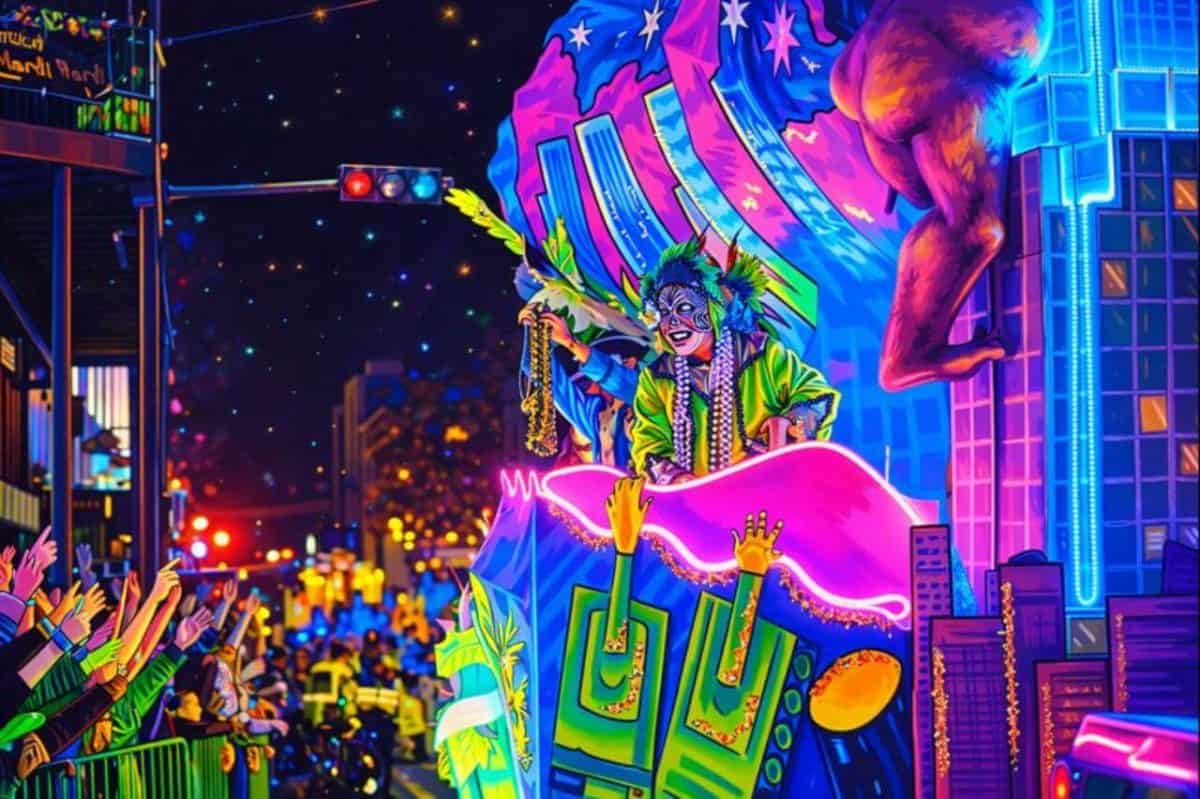
Parades form the most visible expression of Carnival season. In and around Mobile, more than 80 parades are scheduled in 2026, many stretching for hours and filling entire neighborhoods with sound, motion, and color.
Each parade reflects a different identity. Some highlight women-led organizations. Others lean heavily into satire, pop culture, or fantasy themes. The scale varies widely.
Massive parades feature thousands of riders and dozens of floats. Smaller events roll by with floats built from shoeboxes, proving creativity matters more than size.
Preparation demands time and investment from krewes. Riders craft costumes, design throws, and plan performances months in advance.
On parade day, spectators line sidewalks with hands raised, hoping to catch beads, cups, toys, and more elaborate items like painted coconuts or hand-decorated keepsakes.
One of the largest krewes estimates tossing more than 15 million throws during its parade route alone.
Traditions That Take Different Shapes Across Communities
Carnival carries different meanings depending on the place. In rural parts of Louisiana, communities gather for Courir de Mardi Gras, a roaming celebration where masked participants travel between homes collecting ingredients, performing skits, and ending the day with a shared gumbo.
In New Orleans, Mardi Gras Indian tribes continue a tradition dating back to the late 1800s. Participants wear detailed beadwork and feathered suits while singing, drumming, and dancing through neighborhoods.
The practice honors Native Americans who aided Black residents and preserves a cultural expression that developed during segregation.
As Carnival season unfolds in early January, those varied traditions move forward together.
The beads, the food, the music, and the pageantry have settled back into place. Along the Gulf Coast, the calendar has shifted once again, and Carnival has taken over the weeks ahead!
If you’d like to check out other news stories, hop over to our news corner.


